Tag Archives: poetry


Goodbyes

Some goodbyes are sweet —
You smile and hug and kiss
And say the word, believing
That you’ll be better people
When you see each other again.
Some goodbyes are bitter —
You turn your back
Perhaps with tears
Or with a frown, hoping
You’ll never have to see each other again.
Some goodbyes are not meant to be —
You think it is over
That the last chapter has been written
And another one cannot be added.
But then a sequel is started.
Some goodbyes are inevitable —
You hate to part
You know you shouldn’t
But you’re not characters in a book
Or lovers in a rom-com….
These goodbyes leave you feeling cold and empty
Like a house stripped
Of every furniture, curtain and picture,
Of every sign of being lived in,
And all that’s left is a hollow sound
And the echo of one’s sigh
And the memories of a voice…
Such is the goodbye that, in my ear,
You gently whispered
As you kissed away
A tear on my cheek
And softly,
Quietly
Left me
For good.
*****
“Love is so short, forgetting is so long..” is a line from one of my favorite Neruda poems, “Tonight I can Write.” I think it’s a beautifully sad poem that captures not only the pain one feels at the thought that love has gone, but also the courage to imagine that the person one has loved so passionately will eventually move on.
Tonight I can Write by Pablo Neruda:
Click here for the English and Spanish versions.
Click here to listen to Andy Garcia’s reading of the poem.
Share this:

You’re special

Dear Son,
You are special to me
Not in the same way
The world calls you special
Because you can’t speak
The way kids your age do,
You can’t throw a ball
Like most 5-year olds do
You can’t even catch one
Though we’ve tried to teach you
Over and over again.
You are special to me
But not in the same way
The world sees you
Because you flap your hands
Or jump a thousand times on the trampoline
Or recite your books from cover to cover
Instead of talking with people.
No, you’re special to me
Because I see what the world can’t see
How sweet your smile is
When I finish a line that you start to recite;
When you leave your toys
To run to me just to give me a hug;
When you snuggle close to me
Because you want to be kissed;
When you ask me to sing
Your favorite song
Or read your favorite book.
You are special to me
Not only for who or what you are,
But also because, in your simplicity,
You have taught me —
Patience and understanding,
Humility and gratitude.
And most all you taught me
Love that expects nothing in return
Save for that sweet, little smile
You give to me alone.
Thank you, Son.
Love,
Mom
Share this:

On Words and Immortality

I personally know a few people who look forward to the discovery of making humans immortal. Although I’d be very happy for and proud of humanity should they make such an achievement, I don’t think I will be around long enough for that, and I don’t really wish to become physically immortal.
Having recently seen someone I love suffer, I cannot see the point of prolonging one’s life if one is unable to function normally, both physically and mentally. It is heartbreaking to see a fellow human being’s condition deteriorate like that, especially when it is one you hold close to your heart. It makes you wish you were suffering instead of them.
So, no. Immortality in the physical sense is not for me.
I have said before that I would probably reconsider if life could be painless, and one could remain young and healthy. But I think that is too big a dream for humanity — one I find extremely hard to hope for.
However, some people have successfully immortalized themselves and others they cared about thru arts and literature. There are too many works and artists and writers to mention them all, but one poem that promises immortality thru poetry that has really stuck with me since I first read it as a student is Shakespeare’s Sonnet 18.
Shall I compare thee to a summer’s day?
Thou art more lovely and more temperate:
Rough winds do shake the darling buds of May,
And summer’s lease hath all too short a date:
Sometime too hot the eye of heaven shines,
And often is his gold complexion dimm’d;
And every fair from fair sometime declines,
By chance, or nature’s changing course, untrimm’d;
But thy eternal summer shall not fade
Nor lose possession of that fair thou ow’st;
Nor shall Death brag thou wander’st in his shade,
When in eternal lines to time thou grow’st;
So long as men can breathe or eyes can see,
So long lives this, and this gives life to thee.
The first two quatrains of Shakespeare’s Sonnet 18 explains why the speaker cannot possibly liken the subject (supposedly a young man but some people insist it’s a woman; it doesn’t matter to me) to a summer’s day. The third quatrain explains further how time nor death cannot rid the subject of his/her beauty.The couplet promises eternal life to the subject, saying, for as long as people can read this poem about him/her, he/she will always live.
And the poet has been proven true to his promise. We are still reading about the young person’s beauty. You are reading about it now as you are reading my post.
To me that IS immortality.
How (in what way) would you like to be immortalized?
Share this:

The Tryst

As I lie in bed
Waiting for the husband
To put down his book,
I think of the words,
Imagine them flowing,
Hearing the sound,
Savoring each syllable.
As soon as the light is off
I wait a little more
For the eventual snore
A sign that I was free
To get up
And to be
With my lover.
I check on the little one
Sleeping like an angel,
And then, quietly, I go
To meet with my lover,
For my lover makes me feel
And think
And smile.
My lover heals me
And comforts me
And helps me move on.
As I step into the room
And walk towards the table
Where everything
Will soon commence,
I say to myself,
Now I can do this.
I can let the words out.
I am in love with words.
And writing is my lover.

If it isn’t obvious yet, it’s written tongue-in-cheek. A reaction to the questions asked of me recently: what I’ve been doing with my time and why I like being alone. 🙂
Why do you write?
Share this:

Like you used to

For my Miming
Today I read something that made me laugh
And I thought of you, and for a second,
I thought of picking up the phone
To tell you the story,
And hear you laugh
Like you used to.
But then I remembered
That I had already said my goodbyes
That I won’t ever hear your voice again
Nor ever see your eyes disappear
As you laugh at my silliness,
Like you used to.
You’re no longer here.
That’s something
I have to get used to.
Share this:

Insignificant

“No one can make you feel inferior without your consent.”
You’re like …
A tiny, withered leaf
On concrete ground —
Invisible except to those who look down,
Unappreciated save for a few sensitive souls
(Who see it and wistfully smile)
Too small to catch anyone’s attention
But for the sweeper’s who thinks
It does nothing for the neatness of the ground.
——
Some people feel so small; they feel they have nothing to contribute to this world, that nobody knows them, that nobody likes them. They are worse off than Dostoevsky’s man from the underground, who at least thinks/knows he is smart.
These people feel that when they finally leave this world, nobody will mourn them, nobody will remember them. There will be no flowers on their graves.
I feel small, too, but only when I think of the massiveness of the universe; I feel I am extremely insignificant. What does my life matter to the universe? It will go on, and not a thing about it will change when I die because I am just a speck of dust in its vastness.
But then again….
One may be small, seen and appreciated by only a few. But who needs too many people in one’s lifetime? One cannot possibly know all their names and all their stories. One only needs a few sensitive souls to see through one’s soul.
Though one may be small, insignificant to most, one can be the world to somebody else. One can make oneself the center of somebody’s universe by one’s selflessness and sincerity and generosity.
Make your life matter.
Share this:

Neruda’s “If You Forget Me”: A Lesson in Loving
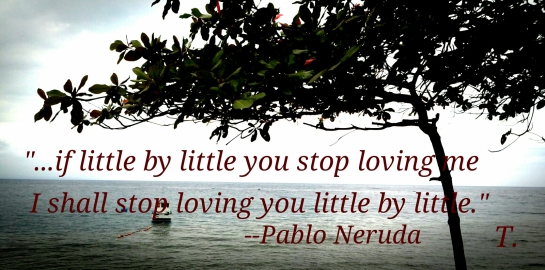
Centennial Park, Iligan, Philippines
Whether Pablo Neruda wrote this poem for his country, Chile, or for his wife, Matilde Urrutia does not make much difference to me. I like the kind of love portrayed in this poem. I like the tone of the speaker as he warns his lover …
“If you forget me
I want you to know
one thing. ”
It is not the sound of a desperate, pathetic lover who begs or promises to continue to wait even though the other has moved on.
It shows a speaker who thinks and is not controlled by silly emotions, a speaker/lover who demands reciprocity in a relationship.For truly, if one can be, and is reasonable, one will demand reciprocity in a relationship.
(Even God demands, commands love and faithfulness!)
“If suddenly
you forget me
do not look for me,
for I shall already have forgotten you.”
Who wants to be forgotten by the one person you cannot forget? Of course, trying to forget someone is easier said than done. The more you try to forget, the more you will be reminded. This is perhaps the speaker’s way of saying, “Don’t think I will be pining for you. I will forget you before you can completely forget me!”
“If you think it long and mad,
the wind of banners
that passes through my life,
and you decide
to leave me at the shore
of the heart where I have roots,
remember
that on that day,
at that hour,
I shall lift my arms
and my roots will set off
to seek another land.
“…and my roots will set off/ to seek another land.” This is how it should be. One should be brave in seeking and starting a new life and not waste time and energy on someone who has forgotten.
Yet….
Though the poem begins with a kind of warning, a threat as to what the speaker can do should his lover forget him, it ends with a promise, an enticement as to what he can give if his lover remains true to him,
“…ah my love, ah my own,
in me all that fire is repeated,
in me nothing is extinguished or forgotten,
my love feeds on your love, beloved,
and as long as you live it will be in your arms
without leaving mine.”
Reciprocity.
- Click here for the English version of the poem
- Click here for the Spanish version (Si Tu Mi Olvidas)
- Click here to listen to Madonna read the English version of the poem.
Share this:

Playing Dead
For My Miming

You used to play dead
When you felt
I wanted
Too much attention.
You would close your eyes
Stiffen your body
And hold your breath for a minute
Not making a sound, not moving an inch,
Making me think
You were dead
That you’d left me
And it was my fault.
You used to enjoy telling people
How scared I was as I shook your body
How hard you tried to control your laughter,
And how smart I was
To tickle your foot to “wake” you up.
Now as I look at how your lids don’t move
As your eyes are closed
Your body stiff and cold to the touch,
I am tempted to tickle your foot again.
But I’m not a child anymore
And I know this is no longer the silly game
That the once-goofy mother
Used to play with her youngest child.
The machines don’t lie
You’re gone.
You have really left me
And you won’t wake
No matter how many times
I whisper in your ear
Or squeeze your hand
Or kiss your cheeks.
The game has ended.
And I lost.
Share this:

Stop. Look. Listen. Feel. Be grateful. Move on.

Sunset at Dalipuga, Iligan, Philippines
One of my favorite poems that I can recite by heart is Robert Frost’s Stopping by Woods on a Snowy Evening. I kept reciting this poem to my baby when I was still pregnant, and even after my son was born. HBO’s Classical Baby The Poetry Show includes a reading of this poem by Susan Sarandon, and it is now my 5-year old son’s favorite part of the video.
A thought came to mind today as I watched my son give me the sweetest smile when the video clip began. A few months after our son was diagnosed with Autism, my husband wished Eli would not grow so quickly. Today, only for a moment I wished Eli would never grow up, so people can excuse his strange stimming habits, his speech delay and other autistic traits. Every now and then I worry about whether or not he will be able to live independently, when my husband and I won’t be around to look after him anymore.
Frost’s poem talks about how we, once in a while, encounter something that makes us wish could last at least a lifetime, but we all have other things to do — duties, responsibilities, roles to play in other people’s lives — so we have to move on, continue living our lives.
The speaker in this poem though was truly in the moment. He noticed his surroundings: the snow-covered woods, the frozen lake; he heard the sound of the harness bells and the wind. He also used his imagination (“My little horse must think it queer…”), and was quite aware not only of the lack of danger (…He will not see me stopping here/ To watch his woods fill up with snow), but also of his responsibilities and of the life he had to live, (But I have promises to keep/ And miles to go before I sleep/ And miles to go before I sleep.)
Oftentimes I look at my son and wonder what life will be like for him. Will he ever be able to speak like a neurotypical person? Will he be able to read by himself the books that he loves for me to read to him? Will he be able to write down his own name? But then I stop myself from doing this, and instead do things with him. Not much use wondering about the future when so much of it depends on the present.
What I liked most about Frost’s poem is the idea that though we can (and we should) live our lives — face our responsibilities, fulfill our duties, find our way in the darkness — we can stop once in a while and just enjoy what we have in our lives: food on our table, clothes to keep us warm (or cool), roof over our heads, air we breathe, water we drink, family, friendship. And love. And faith that everything will be all right in the end.
Thank you. Salamat. 谢谢。
Share this:

As you lie there

What goes on in your mind

As you lie there, awake but unable to get up?
What dreams do you have
When pain killers stop the pain
But play tricks with your brain
And make you smile, or frown
Or scared like a little girl
Crying out for her mom,
While asleep?
Do you hear people talking
About you,
How you have changed?
How it breaks their heart to see you so?
Do you hear us when we talk to you?
To tell you that we’re sorry,
That we love you,
And that we’ll be fine,
No need to worry?
Share this:

Travel Woes

Afternoon clouds over Visayas, Philippines. I was so excited to see this cloud formation. Looks like a duck, don’t you think?
Pack.
Unpack.
Pack.
Unpack.
I could fill this page
With the same words
According to the number of times
I had to
Pack.
Unpack.
Barely had the time to start shedding
The pounds from stress eating
And I’m stressing and stress eating again.
Someone once said to me,
When tragedies pile up
Then you have a comedy.
How come I’m not laughing?
March 3, 2016
Share this:

The excitement over meeting at night

No moonlight photos because I found I have never taken good enough photos of the moon. I seldom go out at night these years. Sigh
Click here to hear a reading of the poem.
(So why am I talking about love again? Because I’m tired of hearing people tell me I look tired or miserable. In short I’m tired of feeling tired. Logical? No? I don’t care.)
This poem has a sister poem called “Parting at Morning.” But I don’t want to talk about parting. Meetings are exciting. Partings can be beautifully sad or sadly beautiful, both of which are my usual preference, but I’m not in the mood to be sad. So, exciting things for now.
Now let’s imagine this man traveling on a boat, obviously all by himself, on a dark night and crossing quite a distance (“three fields”) to meet with his lover — a woman (this is Victorian poetry, and we know Browning wrote this for his wife, Elizabeth Barrett, so.) He braves the darkness and the distance to be with her. One can feel the excitement in the imagery in the third and fourth lines of the second stanza. In the darkness — a small light, and a soft familiar voice.
I’ve read some analyses of this poem, but not thoroughly because I do not like to be influenced heavily by what others say about this poem. I prefer to have my own understanding of any poem. We did read this in our poetry class some twenty years ago (ouch!), all I remember is the sound of my professor’s voice reading it. It was always relaxing.
I digress.
This poem is often interpreted as having a male speaker because the poet is male. But read the poem again and imagine the speaker being a woman. Does that work for you? It certainly does for me.
Reading this poem in the 21st century, one may ask, why can’t the speaker be a woman? Surely, women can “gain the cove with pushing prow”? Women can cross “three fields” to get to the secret meeting place? I bet a lot of women have braved weather and distances to meet with a lover.
But whether the speaker is male or female is not my main point. My main point is actually quite simple: when you’re in love and you have to meet with the object of your affection, meeting in secret, especially at night, can have its excitement that for the moment you wish would never end.
But of course it ends. Duh.
Share this:

On Trying to be Good

Sunset over Mindanao Sea (Bohol Sea), Philippines
My heart has been “battered” for weeks now, so I’m not praying for more; but these days this sonnet has been like an earworm (brainworm) in my head.
Holy Sonnet XIV by John Donne
Batter my heart, three-person’d God ; for you
As yet but knock ; breathe, shine, and seek to mend ;
That I may rise, and stand, o’erthrow me, and bend
Your force, to break, blow, burn, and make me new.
I, like an usurp’d town, to another due,
Labour to admit you, but O, to no end.
Reason, your viceroy in me, me should defend,
But is captived, and proves weak or untrue.
Yet dearly I love you, and would be loved fain,
But am betroth’d unto your enemy ;
Divorce me, untie, or break that knot again,
Take me to you, imprison me, for I,
Except you enthrall me, never shall be free,
Nor ever chaste, except you ravish me.
People raised to believe in heaven and hell, or just raised to be a good person and to be sorry for doing bad things, most likely feel guilty for being bad and continually endeavor (and, perhaps, still fail) to be good.
The sonnet expresses that desire to be good (to be with God) again, and the supplicant is willing to be cleansed in any way (by God) just to become pure again.
Perhaps because it’s the Lenten Season, or maybe it’s just because somebody reminded me of this sonnet, that it’s stuck in my head, but it’s been awhile that I have not prayed like this.
Arrogance? I don’t think so. Too busy living? Maybe. Had enough? Well….
Share this:

Mother’s Memories

You stared blankly into space
As if looking at something
That only you could see.Then you opened your mouth to speak
About old friends and the fun times you had with them
And how there was only peace among everyoneYou said you wanted to go back to the old house
With the people you say were your real friends.We wish we could give you what you want.
But the house has been gone for over half a century
And your friends’ tombstones have even fadedI wiped a tear away as I felt I was no longer in your memory.
But I braved myself to ask, “Do you know who I am?”
You turned to look at me and softly said my name,And added, “My dearest child.”
Share this:

On living, loving and leaving

Sonnet 73 by William Shakespeare
That time of year thou may’st in me behold
When yellow leaves, or none, or few, do hang
Upon those boughs which shake against the cold,
Bare ruin’d choirs, where late the sweet birds sang.
In me thou see’st the twilight of such day,
As after sunset fadeth in the west,
Which by-and-by black night doth take away,
Death’s second self, that seals up all in rest.
In me thou see’st the glowing of such fire
That on the ashes of his youth doth lie,
As the death-bed whereon it must expire
Consum’d with that which it was nourish’d by.
This thou perceivest, which makes thy love more strong,
To love that well which thou must leave ere long.
There has been much debate on the meaning of this sonnet, particularly the last couplet:
This thou perceivest, which makes thy love more strong,
To love that well which thou must leave ere long.
What is the young man supposed to eventually leave before long: his friend or his own youth?
I will not join in the debate, but I am quoting the sonnet here because I was reminded of it (and John Donne’s Sonnet 10) twice today: first, when I read this poem by John White called Laughing about it ; second, when I read Temple Grandin’s tribute to Oliver Sacks, who also wrote a moving article reflecting on his relationship with his Orthodox family and the Sabbath.
Whether the speaker meant that the young man had to leave his friend or his youth, to me, is not the point, rather that the knowledge that one is leaving something valuable makes one appreciate it or love it even more.
My first real understanding of this line happened one summer day when my best friend and I stood in a forest, listening to the sound of the leaves of the trees as the breeze was passing through, and I said it was beautiful I wish it could last forever; and he said it was beautiful simply because it was not going to last.
(Not long after that my best friend left, and for a while, that memory always made me cry. But with time, I have learned to call on that memory, and it just brings a beautiful feeling.)
If we truly love someone or something –a place, a person, a pet or life itself — the knowledge of our imminent leaving of it/them will make our love for it/them even stronger.
Perhaps it is the best way to live every minute of our short life here: to always remember that we won’t be here forever, that we are always about to leave. Perhaps then we can love wholeheartedly, not only for a minute or an hour or for a day, but for a lifetime.
Share this:

Love in the time of Computers
How many times have I fooled
Myself into hoping
That you’d come
Knocking at my door
To surprise me
To make me smile
Like you used to.
Why is it so hard
To store in this brain
That you had moved on
But left everything
For me to process
And decode the meaning
Of your sudden leaving.
Isn’t it enough
That you had left
(Not the country,
Though I sure wish you would!)
And that you see me
See you happier
Without me?
But ah, this brain
This brain has faulty programming.
Its memory is full.
It cannot store new data
And none can be deleted.
It can only self-destruct,
In due time.
Share this:

On Growing Old
“I grow old… I grow old… I shall wear the bottoms of my trousers rolled.”
-T.S. Eliot
I have a lot on my plate lately, and don’t have the time to be quiet nor to have a good conversation with people I can really talk with, so yesterday as I sat down to rest for a few minutes I thought about how many strands of white hair could be growing out of my head. I decided to just laugh about life instead of worrying about it. I’m not ready to dye my hair.
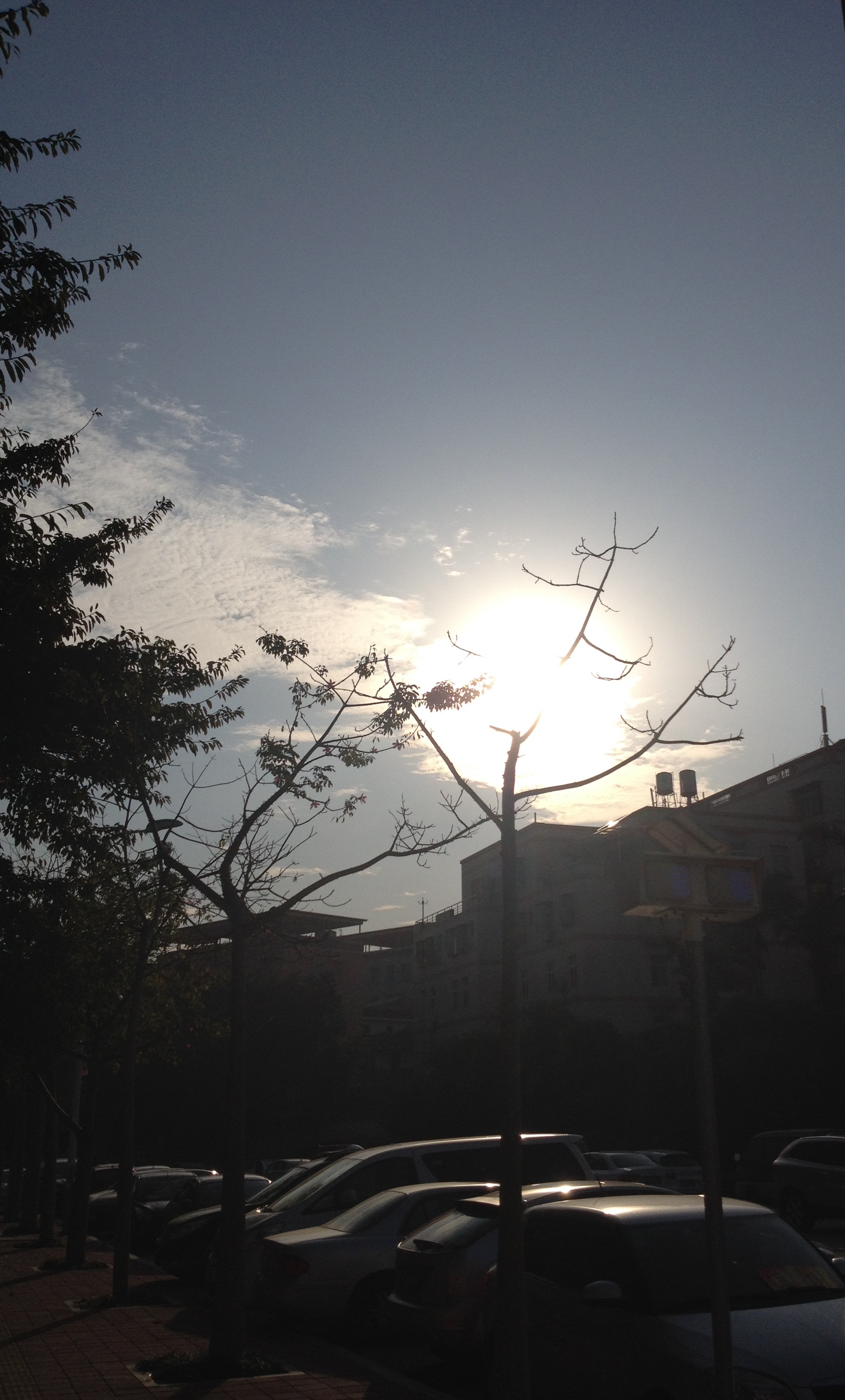
Winter afternoon sun in Jimei
With every misfortune,
And every disappointment,
And angry and hurtful words,
With every neglect
And every apathy
And unwelcome silence,
I can feel white hair
Growing out of my scalp.
I swear I can hear each strand
As it wriggles its way out.
And I look at myself in the mirror
And I look for those strands of white
There’s one close to the right ear
And another one by the hairline,
And then there’s none.
Perhaps those two came out
Because I worried
That because I worried,
I would grow old.
Share this:

Musing on mornings

Jimei has a beautiful campus. I walk to work around 7 in the morning four times a week, and each time, I walk slowly so I can enjoy the scenery.
I am a morning person. I get up at 4:30 in the morning most days and do my ritual of making coffee, reading the news, mopping the floor, doing a 20-minute workout, grabbing a bite, then taking a shower. If I miss one of those in the list, I get a little disoriented.
These days the morning air is so cool that when I open the kitchen window and hear the rustling of the leaves and the merry chirping of the birds, and feel the cool touch of the breeze on my face, I am reminded of two poems: one by Wordsworth and the other by Hopkins. (I’m serious. If you have ever been taught Poetry by a professor as poetic and romantic as Dr. Anthony L. Tan, and lived in a convent — trying to become a nun– for a few months, then you’ll understand my way of thinking.)

Composed Upon Westminster Bridge
By William Wordsworth
Earth has not anything to show more fair:
Dull would he be of soul who could pass by
A sight so touching in its majesty:
This City now doth like a garment wear
The beauty of the morning: silent, bare,
Ships, towers, domes, theatres, and temples lie
Open unto the fields, and to the sky,
All bright and glittering in the smokeless air
Never did sun more beautifully steep
In his first splendour valley, rock, or hill;
Ne’er saw I, never felt, a calm so deep!
The river glideth at his own sweet will:
Dear God! the very houses seem asleep;
And all that mighty heart is lying still!

God’s Grandeur
Gerard Manley Hopkins
The world is charged with the grandeur of God.
It will flame out, like shining from shook foil;
It gathers to a greatness, like the ooze of oil
Crushed. Why do men then now not reck his rod?
Generations have trod, have trod, have trod;
And all is seared with trade; bleared, smeared with toil;
And wears man’s smudge and shares man’s smell: the soil
Is bare now, nor can foot feel, being shod.
And for all this, nature is never spent;
There lives the dearest freshness deep down things;
And though the last lights off the black West went
Oh, morning, at the brown brink eastward, springs—
Because the Holy Ghost over the bent
World broods with warm breast and with ah! bright wings.
Even though I am no longer so certain about the existence of God, the beauty of the morning somehow brings back my sense of gratitude to the creator of such beauty, and since in my simple brain, there are no other candidates for that position, then let it be God for now.
Early morning, I find, is much more beautiful than night time. (Or is it just that I am getting old and can no longer appreciate the beauty of darkness where sweet words are whispered and gentle touches are felt?)
When I take an early morning walk, and see the dew on the leaves and feel the damp earth, and hear the birds sing, and smell the grass, I am always filled with that kind of bliss that makes one want to love the world and to desire to be a better person deserving of such wonder. For someone who has been waiting for death since she was 20, this is one of the very rare moments when I am actually happy about life, one of my Sisyphus-reaching-the-top-of-the-hill moments.
The awareness of the ephemerality of these moments is probably what makes people, like me, appreciate them more.
Like everything else in this world, they come to an end, sometimes too soon, when I start hearing the honking of vehicles and seeing people push and shove each other to get on the bus to get to work.
But this is life. I am just grateful to know that there is time, when I need it, for nature to refresh me and make me ponder on how good it is to be alive.


 Thoughts on Life