
Nothing New

“One of the things that’s really striking about philosophy is how interesting and insightful some of the philosophers of the past still are for the present, so it’s still interesting to look at Aristotle, still interesting to look at Rousseau, or Nietzsche today and think about despite the internet, despite the social changes, how many things they said still resonate …. I don’t think it’s obvious we’ve progressed, i just think we’re responding to a different situation.” — Nigel Warburton, Philosophy Bites podcast


I was listening to an old episode of Philosophy Bites last night, when Nigel Warburton, who was being interviewed by David Edmonds about his book, said the words quoted above. My ears perked up, simply because I think it is so true. Plato already covered everything , especially in political philosophy. As Alfred North Whitehead said, “All of Western philosophy is but a footnote to Plato.”


And it made me think about how there’s really nothing new in how we respond to current situations. For sometime now people have been complaining and/or worrying about how smartphones and social media are making humans less social. Time will tell if they truly make us less social, but remember when many articles were written about television ruining family relationships as each member had their own TV and were not talking as much as before they had the TV? The TV is still around, and there are still families who are together. Although it is true that people are always on their phone, they still find time to hang out with families and friends. People still try to reach out and meet in person — at least my family, friends, relatives, co-workers do. And judging from the photos in my social media, there are many people who enjoy spending time with other people.


Going back farther in time, Socrates thought writing was not good for the memory. But now people actually think that writing by hand helps us remember better than typing does. Maybe in the not so distant future, somebody will argue that typing is better than dictation, and dictation is better than the next invention.


I used to worry a lot about what the world would be like when the younger generation have become so self-absorbed and apathetic about certain things. But then I remember my mother’s generation and how worried they were about the same things, observing my generation. Of course they thought they were better than my generation. And now my generation think we are better than the current generation. And this current generation will think they are better than the next one.


So there’s nothing new. No new ideas, no new reactions. Just a different setting with characters who are under the illusion that they and their experiences are unique.


As Robert Browning famously said, “God’s in his Heaven,/All’s right with the world.”


Maybe not everything is alright in your world right now, but that will come to an end, for sure. Though good things come to an end, the good news is that bad things come to an end, too.

Blessings.

T.

Numbers: A Poem

What if each life holds a number

Our mortality, on this code, depends?

A sequence of numbers, an algorithm

Dictates our fate —

How long one lives, how short one’s life,

Who goes first and when?

Who lives longer and till when?

And if our math geniuses crack the code,

Could we cheat death, retain our place?


I submitted this poem to a journal, and the editor was nice enough to email me back saying, “Although it wasn’t accepted for publication, we enjoyed reading your work.” I thanked him for letting me know.

But it really made me wonder what he meant by “we enjoyed reading your work.” Did he mean they thought it was funny? Hehehe.

Anyway, it’s fine. I can always post my poems here, and hopefully someone, somewhere will read it and think about life and reality.

This poem came to me when I woke up in the middle of the night and realized the podcast I was listening to was still on — the host was talking about Pythagoras and numbers. I wasn’t fully awake when the thought came to me.

Anyway, when I showed the poem to my husband he said sarcastically, “Are you Catholic? You think we’re just programs? You think God is a programmer?” 😛

Have a lovely week! 🌹

T.

Books in a café

At Xiamen Gaoqi Terminal 3

While waiting for my flight yesterday, I bought a coffee at this café at Xiamen Gaoqi Terminal 3 and was so happy to see a variety of very interesting English books — from the illustrated Guess How Much I Love You which is one of my son’s favorite books, to a book of Shakespeare’s sonnets.

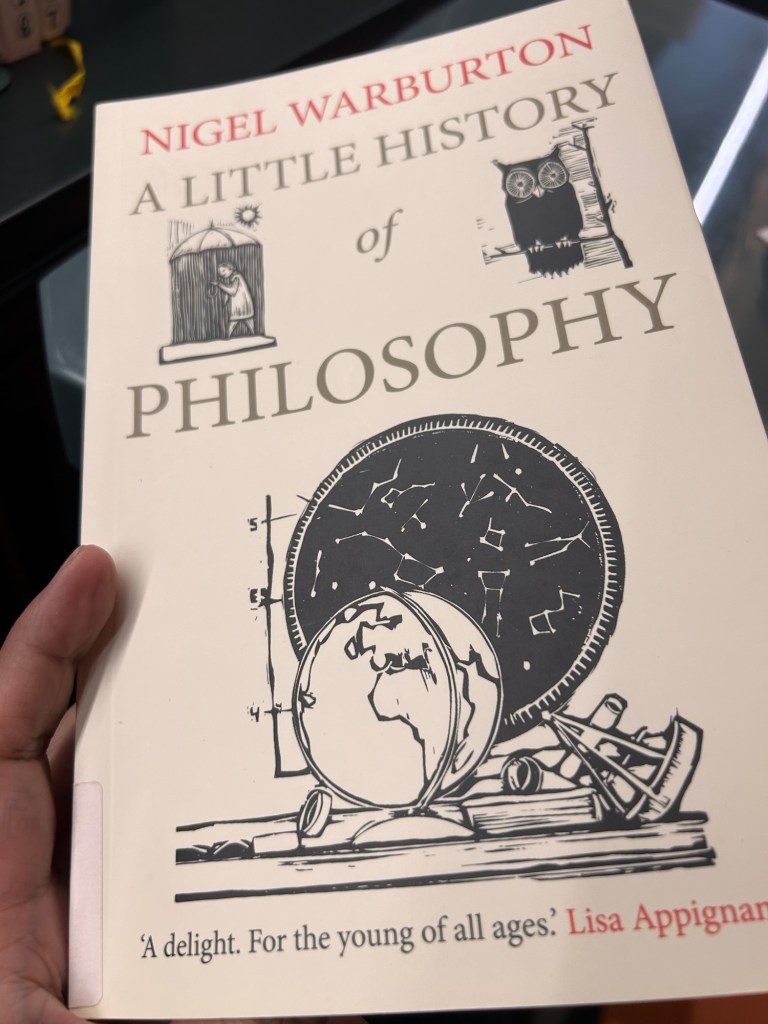
But one book that made me wish I was in a bookstore not a food place was Nigel Warburton’s A Little History of Philosophy which I really enjoyed reading.

I’ve been listening almost every night to Philosophy Bites for about a year now; I have favorite episodes that I’ve listened to many times. Reading Warburton’s book is truly “A delight. For the young of all ages.”

I asked the staff if I could buy the book and was told it’s not for sale. Luckily it’s available on Kindle for about $10, and I bought it and read it on the plane.

The other book I saw and started reading but will continue reading later is What To Do When I’m Gone.

It’s a beautifully illustrated book by a writer mother and her artist daughter.

The introduction moved me to tears as it reminded me of the times after my mom’s death when I realized she was no longer just a phone call away. There was no one I could call and cry to and ask to pray for me.

I don’t usually hang out in coffee shops or cafés in airports while waiting for a flight. It was serendipitous that I stopped at Miss Zhao’s Café.

Happy Wednesday from the Philippines!

On “A theory of everything”

An introduction to this book on Amazon: “A ground breaking model of the universe that redefines our space-time reality from base dimensional interactions. With exact definitions of time, energy and matter that fully resolve the duality of light – as well as clearly explaining and contextualising the roles of relativity, string theory, quantum mechanics, the 4 forces, radioactivity, chemistry and the periodic table, thermodynamics and entropy, magnetism and electricity and much more. All of these combine into a complete working model of the universe which is able to explain in plain English how everything works from a fundamental viewpoint.”


My friend, GeNie, (not his real name, of course, but you’ll understand why he chose this nom de plume, a couple of chapters into the book) finally came out with the book he’d been working on the past year (or a couple of years?) Even though he told me it was “just about everything” when I had asked him what the book he was writing was about, I just thought it was an exaggeration, but reading the first few chapters of the book made me realize it IS, indeed, a theory of everything!

I find it impressive that he is able to write down his thoughts and organize them and express them in a very conversational manner. I am not a science person, so I cannot make a thorough review, but as an ordinary reader, and a friend, I am amazed by his determination and achievement in coming up with a book that contains his ideas/thoughts that he must have been musing on for years!

Give it a read, and let us know what you think!

The brain and the concept of evil

img_6486

“Why did evolution invent conscious experience and pain if we are machines, in principle no different from cars?”  — Henry Marsh, Robert Sapolsky’s Behave is tour de force of science writing. 

I have finally found a book that articulates what I have been thinking about for the last couple of years. (I haven’t read it yet, but I will very soon as I’ve already ordered on Amazon.)

In his review of the book, Marsh says, “Sapolsky uses the analogy of a car with faulty brakes to describe antisocial human behaviour. A mechanic will not accuse the car of being evil but instead will explain its bad behaviour in terms of its malfunctioning parts. Human behaviour is no different – it is determined by the mechanics of our brains. The difference is that we understand very little about them and so we invoke the mythical concept of a controlling self (which Sapolsky describes as a homunculus) located somewhere in our heads. Concepts such as ‘evil’, he argues, have no place in the modern world of scientific explanation. If people behave badly, it is because of the neurological, genetic, hormonal and environmental determinants that shaped their brains, not because of any evil nature. He concedes that punishment may be necessary as a deterrent but is adamant that it should not be seen as a virtue.”

Last year I wrote about my thoughts on people’s lack of control on their negative behavior as it may be determined by a malfunction in their brains (On Compassion, Forgiveness and the Brain ) Today, I came across Marsh’s review of Sapolsky’s book, and I am so happy that a renowned neuroendocrinologist and author from Stanford actually wrote about how the concept of “evil” has no place in the modern world of scientific explanation.

I can’t wait to read this :

Robert Sapolsky, Behave: The Biology of Humans at our Best and Worst 


Daily Prompt: Prefer 

“You have your way. I have my way. As for the right way, the correct way, and the only way, it does not exist.” — Friedrich Nietszche

The other day I was talking with best friend number 3 who asked what’s up with me  reading about philosophy now when it’s dead. I told him I’ve been interested in philosophy since I was 19, I just don’t talk about it much except with my husband (best friend number 1.) And as for philosophy being dead, I think for as long as human beings can think and feel the way we do now, there will always be philosophy.

I have three best friends whom I enjoy spending time with — and two of them almost always disagree with what I say. I’ve known M. who is best friend number 2, for 20 years now, and he is still sarcastic when he talks with me and always tries to makes me see that my arguments are either weak or  “stoopi” (he still can’t pronounce stupid correctly. Lol ) Best friend number 3 is more or less the same — mocking me for my interests and telling me I’m wasting my time reading about these things.

Yet I prefer spending time and talking with any of my three best friends any time than with any other acquaintance. With some people I easily get upset when I am judged for my ideas. I can say I don’t care what they think, but their words can really hurt me. But with these three, they can be brutally honest with me, and they have, and I can still laugh and be grateful to them for being themselves with me and for accepting me for what I am.

We each have our preferences, our own ways of seeing things,but these have not stopped us from being friends.

Prefer

Interstellar and the Self

interstellar

Interstellar


(photo source)

First off, if you have not seen the movie yet, then stop reading.

Second, if you are a film enthusiast or a film critic, then pardon my own humble review of the movie. I am often told that I miss the point of a movie, to which I reply (but only in my head), so what? I see other things in a movie that move me, and to me that is what matters. I do not have to have the same analysis as everybody else. Our understanding and appreciation of a movie or even a book is ultimately shaped by our own individual experiences, our knowledge of the things around us,  our values, culture and many other factors.

That may have sounded like an attempt at apologetics, so I will move on.

I watched Interstellar a week ago, but waited until today to write about it because I had to give myself time to think and discuss with my husband (a physics major in university) about one of the ideas the movie presented that really fascinated me.

Cooper (not my dearest Bradley), Matthew McConaughey’s character, left earth and entered another galaxy through a wormhole. His travel with the other space explorers took, for them, just hours, but what was hours for them was years for the earthlings.

I cannot and will not even attempt to explain how the element of time was used in this story, but in my own simple understanding of what happened and in my humble second-language-learner English, let me say that Cooper was able to go back to a certain place in time, specifically that period when his daughter thought there was a ghost in her bedroom that was trying to tell her something. It turned out that that “ghost” was actually Cooper himself, from the future, (future Cooper)  trying to stop past Cooper from leaving his family. But then he was told he could not change the past.

Let me pause here to say something about Biblical allusions or religious undertones of which there is a prevalence in today’s science-fiction movies. Interstellar is definitely not an exception. the most obvious allusion is to the man Jesus raised from the dead, Lazarus. NASA’s mission in the film is called “Lazarus.”

The Bible contains a few stories about how lives had been sacrificed for something new or better to start. Death for some for the birth of new ones, like when God flooded the world and spared only Noah and his family and a few animals; or when innocent children were killed because King Herod was afraid that the child who had been prophesied to become king was born, and he wanted to be certain the child would not live to be king; or when Jesus had to die to save the people.

In the same way, Dr. Brand had concluded that it was impossible to evacuate the whole population from earth, so he formulated plan B which was to start a new population from the fertilized embryos. He was willing to abandon the living for the survival of the species. This is not new or uncommon. I think people are constantly sacrificing other people’s lives for a cause, be they good or bad.

One other thing that I was reminded of when I saw that scene where  Future Cooper was begging his daughter (who, of course could not hear him) not to let him, Past Cooper leave, was hell. Would it not be hell to be able to see our past selves making a decision that at present we know to be very wrong, but we have no way to correct it? The way we live our lives is not like how a movie is made where we do several takes. It is hell to watch ourselves making mistakes that affect not only our lives but also the lives of the ones we love  and knowing we cannot undo those mistakes.

That scene from the movie spoke to me the most — the father’s anguish at seeing his daughter again and wishing he had listened to her and not left her. I love Matthew McConaughey (not the same way I love Bradley Cooper, but yes) I think he is a great actor.

That scene also made me think of “conscience,” that tiny voice in the head that tells  one what is morally right or wrong, the guide to making decisions. I would like to think that our conscience is simply our “future selves” trying to guide us to the right direction. Sometimes we listen to our conscience, sometimes we don’t. Sometimes we even feel it is absent. Maybe on a holiday.

I do not like movies about aliens, but somehow I am a little disappointed that in this movie, the human being seems to be alone in the universe, that there are no other creatures out there, that it is just us in the vastness of the universe. Are we truly this special? That we have such a huge place all to ourselves? I prefer the idea presented by Stephen Hawking that there are other creatures apart from us that are way more advanced  than our civilization. I would like to think that there are other beings out there, that it is not just us on this tiny planet in the infinite universe. This feeling is the same as when I stand on the shore facing the horizon and wondering if on the other side, there is also somebody standing on their shore wondering the same about the other side.

I have so many questions about our existence. I used to think the answer was in philosophy, and then in neuropsychology, but as years pass, I feel the answer can only be found not within ourselves, not within our planet, but out there in the universe, which means I may never know the answers to my questions. It is sad, but I am hopeful one day somebody will find those answers. And that hope and faith is enough to make me go on living my life, hopefully not disappointing my future self too much.