
Books in a café

At Xiamen Gaoqi Terminal 3

While waiting for my flight yesterday, I bought a coffee at this café at Xiamen Gaoqi Terminal 3 and was so happy to see a variety of very interesting English books — from the illustrated Guess How Much I Love You which is one of my son’s favorite books, to a book of Shakespeare’s sonnets.

But one book that made me wish I was in a bookstore not a food place was Nigel Warburton’s A Little History of Philosophy which I really enjoyed reading.
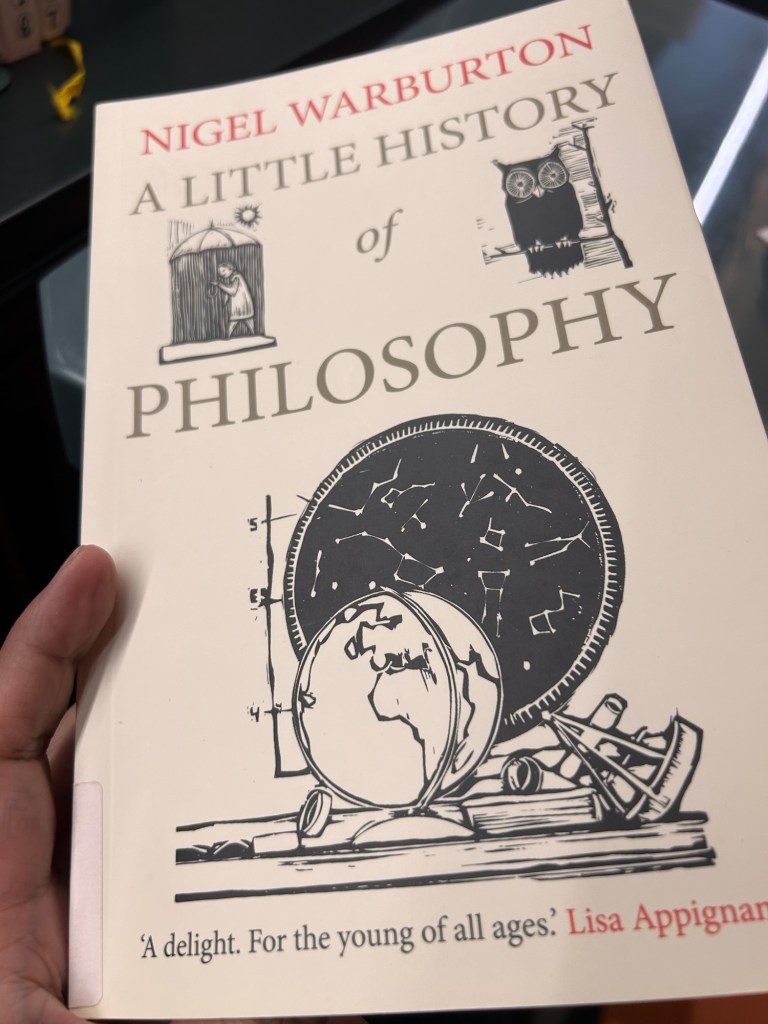
I’ve been listening almost every night to Philosophy Bites for about a year now; I have favorite episodes that I’ve listened to many times. Reading Warburton’s book is truly “A delight. For the young of all ages.”

I asked the staff if I could buy the book and was told it’s not for sale. Luckily it’s available on Kindle for about $10, and I bought it and read it on the plane.

The other book I saw and started reading but will continue reading later is What To Do When I’m Gone.

It’s a beautifully illustrated book by a writer mother and her artist daughter.

The introduction moved me to tears as it reminded me of the times after my mom’s death when I realized she was no longer just a phone call away. There was no one I could call and cry to and ask to pray for me.

I don’t usually hang out in coffee shops or cafés in airports while waiting for a flight. It was serendipitous that I stopped at Miss Zhao’s Café.

Happy Wednesday from the Philippines!

On “A theory of everything”

An introduction to this book on Amazon: “A ground breaking model of the universe that redefines our space-time reality from base dimensional interactions. With exact definitions of time, energy and matter that fully resolve the duality of light – as well as clearly explaining and contextualising the roles of relativity, string theory, quantum mechanics, the 4 forces, radioactivity, chemistry and the periodic table, thermodynamics and entropy, magnetism and electricity and much more. All of these combine into a complete working model of the universe which is able to explain in plain English how everything works from a fundamental viewpoint.”


My friend, GeNie, (not his real name, of course, but you’ll understand why he chose this nom de plume, a couple of chapters into the book) finally came out with the book he’d been working on the past year (or a couple of years?) Even though he told me it was “just about everything” when I had asked him what the book he was writing was about, I just thought it was an exaggeration, but reading the first few chapters of the book made me realize it IS, indeed, a theory of everything!

I find it impressive that he is able to write down his thoughts and organize them and express them in a very conversational manner. I am not a science person, so I cannot make a thorough review, but as an ordinary reader, and a friend, I am amazed by his determination and achievement in coming up with a book that contains his ideas/thoughts that he must have been musing on for years!

Give it a read, and let us know what you think!

The brain and the concept of evil

img_6486

“Why did evolution invent conscious experience and pain if we are machines, in principle no different from cars?”  — Henry Marsh, Robert Sapolsky’s Behave is tour de force of science writing. 

I have finally found a book that articulates what I have been thinking about for the last couple of years. (I haven’t read it yet, but I will very soon as I’ve already ordered on Amazon.)

In his review of the book, Marsh says, “Sapolsky uses the analogy of a car with faulty brakes to describe antisocial human behaviour. A mechanic will not accuse the car of being evil but instead will explain its bad behaviour in terms of its malfunctioning parts. Human behaviour is no different – it is determined by the mechanics of our brains. The difference is that we understand very little about them and so we invoke the mythical concept of a controlling self (which Sapolsky describes as a homunculus) located somewhere in our heads. Concepts such as ‘evil’, he argues, have no place in the modern world of scientific explanation. If people behave badly, it is because of the neurological, genetic, hormonal and environmental determinants that shaped their brains, not because of any evil nature. He concedes that punishment may be necessary as a deterrent but is adamant that it should not be seen as a virtue.”

Last year I wrote about my thoughts on people’s lack of control on their negative behavior as it may be determined by a malfunction in their brains (On Compassion, Forgiveness and the Brain ) Today, I came across Marsh’s review of Sapolsky’s book, and I am so happy that a renowned neuroendocrinologist and author from Stanford actually wrote about how the concept of “evil” has no place in the modern world of scientific explanation.

I can’t wait to read this :

Robert Sapolsky, Behave: The Biology of Humans at our Best and Worst